¶ What is Power Loss Recovery
Power Loss Recovery in QIDI 3D printers is a system that allows the printer to continue a job after an unexpected interruption of electrical power.
While the concept seems simple, the mechanisms that make it possible involve a carefully timed interaction between the motion controller, storage, onboard sensing, and the thermal management system. QIDI printers are designed to detect power interruptions early, store the essential information that defines the current print state, and later rebuild that state in a controlled and safe way.
Power Loss Recovery exists to prevent the loss of long duration print jobs.
Losing such a job would represent a significant waste of material and time.
¶ Power Loss Recovery Workflow
- After the power is cut off, restarting the printer will pop up the following message. Click the "Confirm" tab to continue printing.
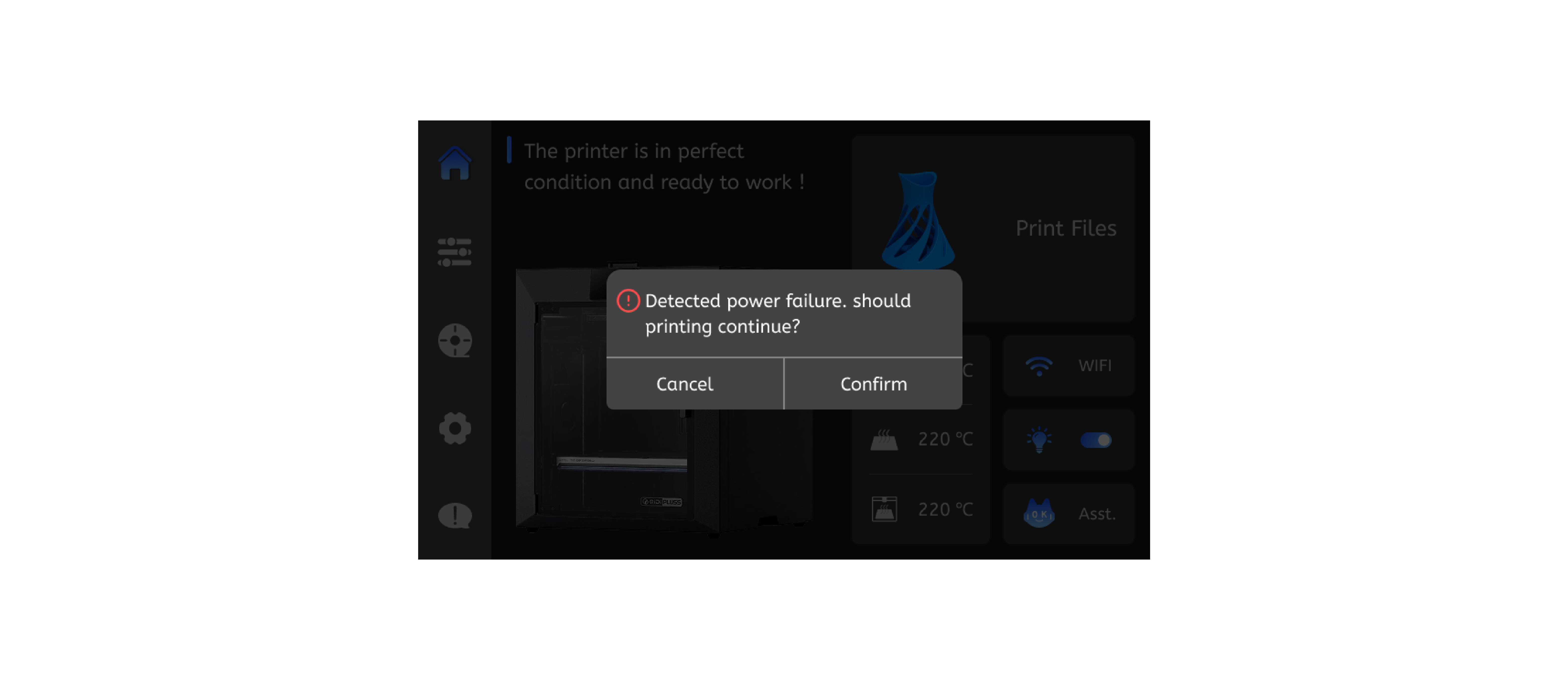
Note: Keep in mind that this feature doesn't work during the first layer.
The default pause time limit for the machine is 72 hours. If it exceeds this duration, the machine will be unable to resume printing. Modify the pause time limit
¶ Filament Behavior and Thermal Stability
The success rate of a power loss recovery is highly dependent on the filament being printed, and the user must carefully evaluate if the print is worth saving or not.
Materials respond differently to unintended cooling. PETG and TPU tolerate pauses well because they exhibit slow shrinkage and maintain surface stickiness after cooling.
PLA cools quickly and may detach from the build plate once the temperature falls below a certain threshold.
Engineering-grade materials such as ABS and PC are highly sensitive to thermal gradients, so even a brief interruption can cause warping or internal stress.
QIDI printers with enclosed chambers help mitigate these issues by reducing airflow and maintaining a more stable environment.
¶ Potential Issues
¶ Warping
When the build plate cools down completely during a long power outage, its surface behavior changes. Once it heats up again, the adhesion can be different from what it was before the interruption.
If you are printing with ABS, even a small drop in chamber or Build Plate temperature can be enough for the model to contract and warp away from the build plate. This can lead to noticeable print defects or even complete print failure.
¶ Model detach
Even if the filament is not usually prone to warping, it may detach from the build plate as it cools without power. PLA is particularly sensitive to this effect. For example, if you were printing a PLA model overnight and the power went out for an hour, the build plate might drop to room temperature. When the printer resumes, the build plate reheats, but the part may have already released slightly / totally from the surface.
¶ Small blob
When a power loss occurs, the nozzle stops immediately at its current position. This will leave a small blob or ooze mark on the printed surface. In some cases, when the print resumes, the nozzle may collide with the small blob, potentially causing a layer shift or even detaching the model.
¶ Visible line
It is normal to see a visible line at the layer where the power loss occurred. This happens because the filament cools and shrinks at different rates during the pause. Materials such as ABS and ASA are especially prone to this effect. The longer the pause lasts during a power outage, the more noticeable this effect may become.
¶ In the end
We hope our guide was helpful. If you have any questions or concerns about the process, please contact our customer service team. We're here to assist you.
We will do our best to respond promptly and provide you with the assistance you need.